Showing posts with label Wisdom. Show all posts

26 January, 2012

Five Reasons Why Allah SWT Uses Problems

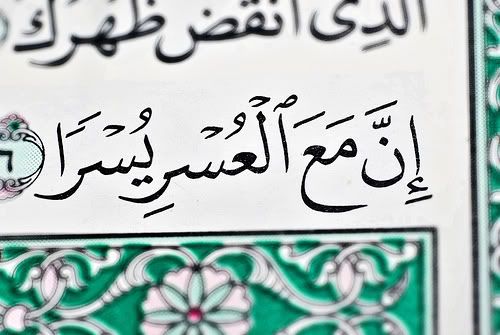
"indeed, with hardship comes relief "  Quran

The problems you face will either defeat you or develop you – depending on how you respond to them. Unfortunately, most people fail to see how Allah wants to use problems for good in their lives. They react foolishly and resent their problems rather than pausing to consider what benefit they might bring.

Here are five ways Allah wants to use the problems in your life:

1. Allah SWT uses problems to DIRECT you.

Sometimes Allah must light a fire under you to get you moving. Problems often point us in a new direction and motivate us to change. Is Allah trying to get your attention? “Sometimes it takes a painful situation to make us change our ways.”

2. Allah SWT uses problems to INSPECT you.

People are like tea bags … if you want to know what’s inside them, just drop them into hot ever water! Has Allah tested your faith with a problem? What do problems reveal about you? “When you have many kinds of troubles, you should be full of joy, because you know that these troubles test your faith, and this will give you patience.”

3. Allah SWT uses problems to CORRECT you.

Some lessons we learn only through pain and failure. It’s likely that as a child your parents told you not to touch a hot stove but you probably learned by being burned. Sometimes we only learn the value of something … health, money, a relationship by losing it. “It was the best thing that could have happened to me, for it taught me to pay attention to your laws.”

4. Allah SWT uses problems to PROTECT you.

A problem can be a blessing in disguise if it prevents you from being harmed by something more serious. Last year a friend was fired for refusing to do something unethical that his boss had asked him to do. His unemployment was a problem – but it saved him from being convicted and sent to prison a year later when management’s actions were eventually discovered. “You intended to harm me, but Allah intended it for good …

5. Allah SWT uses problems to PERFECT you.

Problems, when responded to correctly, are character builders. Allah is far more interested in your character than your comfort. Your relationship to God and your character are the only two things you’re going to take with you into eternity. “We can rejoice when we run into problems … they help us learn to be patient. And patience develops strength of character in us and helps us trust Allah more each time we use it until finally our hope and faith are strong and steady.”

Here’s the point:

Allah is at work in your life – even when you do not recognize it or understand it. But it’s much easier and profitable when you cooperate with Him. “Success can be measured not only in achievements, but in lessons learned, lives touched and moments shared along the way”

Allah SWT Knows Best.
~by Shaykh Salih al-Fawzaan


15 August, 2011

Ten Useless Matters According to Imam Ibn-ul-Qayyim


1- Knowledge that is not acted on.
2- The deed that has neither sincerity nor is based on following the righteous examples of others.
3- Money that is hoarded, as the owner neither enjoys it during this life nor obtains any reward for it in the Hereafter.
4- The heart that is empty of love and longing for Allah SWT, and of seeking closeness to Him.
5- A body that does not obey and serve Allah SWT.
6- Loving Allah SWT without following His orders or seeking His pleasure.
7- Time that is not spent in expiating sins or seizing opportunities to do good.
8- A mind that thinks about useless matters.
9- Serving those who do not bring you close to Allah, nor benefit you in your life.
10- Hoping & fearing whoever is under the authority of Allah SWT & in His hand; while he cannot bring any benefit or harm to himself, nor death, nor life; nor can he resurrect himself.

Wasting the heart is done by preferring this worldly life over the Hereafter, and wasting time is done by having incessant hope. Destruction occurs by following one’s desires & having incessant hope while all goodness is found in following the right path & preparing oneself to meet Allah SWT.

How strange it is that when a servant of Allah has a [worldly] problem, he seeks help of Allah SWT but he never asks Allah to cure his heart before it dies of ignorance, neglect, fulfilling one’s desires & being involved in innovations. Indeed, when the heart dies, he will never feel the significance or impact of his sins.

06 August, 2011

The Wisdom Behind Trials And Calamities

Praise be to Allaah.
There is always a great wisdom behind the incidents of calamities that took place and happened to mankind. Among them includes the following:  

1 – To attain true submission and servitude (‘uboodiyyah) to Allaah, the Lord of the Worlds.
Many people are slaves to their whims and desires and are not true slaves of Allaah. They say that they are slaves of Allaah, but when they are tested they turn on their heels and lose out in this world and in the Hereafter, and that is an evident loss. Allaah says (interpretation of the meaning):
“And among mankind is he who worships Allaah as it were upon the edge (i.e. in doubt): if good befalls him, he is content therewith; but if a trial befalls him he turns back on his face (i.e. reverts to disbelief after embracing Islam). He loses both this world and the Hereafter. That is the evident loss” [al-Hajj 22:11]

2 – Trials prepare the believers to prevail on earth
It was said to Imam al-Shaafa’i (may Allaah have mercy on him): Which is better, patience or tests or prevailing? He said: Prevailing is the level attained by the Prophets, and there can be no prevailing except after trials. If a person is tried he will become patient, and if he remains patient he will prevail.
3 – Expiation of sins
al-Tirmidhi (2399) narrated that Abu Hurayrah (may Allaah be pleased with him) said: The Prophet (peace and blessings of Allaah be upon him) said: 
“Trials will continue to befall the believing man or woman in himself, his child and his wealth until he meets Allaah with no sin on him.” Narrated by al-Tirmidhi (2399), classed as saheeh by al-Albaani in al-Silsilah al-Saheehah, 2280.
It was narrated that Anas (may Allaah be pleased with him) said: The Messenger of Allaah (peace and blessings of Allaah be upon him) said: 
“When Allaah wills good for His slave, He hastens the punishment for him in this world, and when Allaah wills ill for His slave, he withholds the punishment for his sins from him his sin until he comes with all his sins on the Day of Resurrection.” Narrated by al-Tirmidhi (2396); classed as saheeh by al-Albaani in al-Silsilah al-Saheehah (1220).
4 – Attainment of reward and a rise in status
Muslim (2572) narrated that ‘Aa’ishah (may Allaah be pleased with her) said: The Messenger of Allaah (peace and blessings of Allaah be upon him) said:
“The believer is not harmed by a thorn or anything greater, but Allaah will raise him in status thereby, or erase a sin thereby.”
5 – Calamities provide an opportunity to think about one's faults and shortcomings and past mistakes.
Because if it is a punishment, what was the sin?
6 – Calamity is a lesson in Tawheed, faith and trust in Allaah
It shows you in a practical sense what you really are, so you will realize that you are a weak slave, and you have no strength and no power except with your Lord, then you will put your trust in Him in a true sense, and will turn to Him in a true sense, and put aside your position, pride, arrogance, self-admiration and heedlessness, and you will understand that you are poor and in need of your Lord, and you are weak and need to turn to the Most Strong, the Almighty, may He be glorified.
Ibn al-Qayyim said:
“ Were it not that Allaah treats His slaves with the remedy of trials and calamities, they would transgress and overstep the mark. When Allaah wills good for His slaves, He gives him the medicine of calamities and trials according to his situation, so as to cure him from all fatal illnesses and diseases, until He purifies and cleanses him, and then makes him qualified for the most honourable position in this world, which is that of being a true slave of Allaah (‘uboodiyyah), and for the greatest reward in the Hereafter, which is that of seeing Him and being close to Him. “ Zaad al-Ma’aad, 4/195
7 – Calamities drive out self-admiration from our hearts and bring them closer to Allaah
Ibn Hajr said: Yoonus ibn Bukayr narrated in Ziyaadaat al-Maghaazi that al-Rabee’ ibn Anas said: A man said on the day of Hunayn: “We will never be defeated today for lack of numbers.” That upset the Prophet (peace and blessings of Allaah be upon him) and then they were defeated.
Ibn al-Qayyim said in Zaad al-Ma’aad (3/477):
In His wisdom, Allaah decreed that the Muslims should first taste the bitterness of defeat, despite their great numbers and adequate equipment and strength, so as to humble some people who felt proud as a result of the conquest of Makkah and who had not entered His land and His sanctuary as the Messenger of Allaah (peace and blessings of Allaah be upon him) had entered it, bending his head whilst riding his horse to the extent that his chin almost touched the saddle, out of humbleness before his Lord.
Allaah says (interpretation of the meaning):
“And that Allaah may test (or purify) the believers (from sins) and destroy the disbelievers” [Aal ‘Imraan 3:141]
al-Qaasimi (4/239) said:
i.e., to cleanse them and purify them of sin and of pride and arrogance. He also cleanses them of the hypocrites, and make them stand out distinct from them… then He mentions another reason, which is “to destroy the disbelievers”, for if they prevail they will transgress and overstep the mark, which will be the cause of their downfall and destruction. The laws of Allaah dictate that when He wants to destroy His enemies and erase them, he makes available to them the means which will lead to their doom and eradication, among the greatest of which, after their kufr, is their transgression and tyranny in persecuting, opposing and fighting His close friends… Allaah destroyed those who waged war against the Messenger of Allaah (peace and blessings of Allaah be upon him) on the day of Uhud and persisted in kufr. End quote.
8 – To demonstrate the true nature of people, for there are people whose virtue is unknown until calamity strikes
al-Fudayl ibn ‘Iyaad said: As long as people are doing fine, their true nature is concealed, but when calamity strikes, their true natures are revealed, so the believer resorts to his faith and the hypocrite resorts to his hypocrisy.
Al-Bayhaqi narrated in al-Dalaa’il that Abu Salamah said: Many people were confused – i.e., after the Isra’ – and some people came to Abu Bakr and told him. He said: “I bear witness that he is telling the truth.” They said: “Do you believe that he went to Syria in one night then came back to Makkah?” He said: “Yes, and I believe him in more than that, I believe what he says of the Revelation that comes to him from heaven.” And because of that he was named al-Siddeeq.
9 – Calamities strengthen people’s resolve
Allaah chose for His Prophet (peace and blessings of Allaah be upon him) a hard life filled with all kinds of hardship from a young age, in order to prepare him for the great mission that awaited him, which none could bear but the strongest of men, who have gone through hardship and who are tested with calamities and bear them with patience.
The Prophet (peace and blessings of Allaah be upon him) was born an orphan, then it was not long before his mother died too.
Allaah reminded the Prophet (peace and blessings of Allaah be upon him) of that when He said (interpretation of the meaning):
“Did He not find you O Muhammad) an orphan and give you a refuge?” [al-Duha 93:6]
It is as if Allaah wanted to prepare the Prophet (peace and blessings of Allaah be upon him) to bear responsibility and endure hardship from an early age.
10 – Another reason behind calamities and hardship is that a person becomes able to distinguish between true friends and friends who only have their own interests at heart.
11 – Calamities remind you of your sins so that you can repent from them.
Allaah says (interpretation of the meaning):
“Whatever of good reaches you, is from Allaah, but whatever of evil befalls you, is from yourself” [al-Nisa’ 4:79]
“And whatever of misfortune befalls you, it is because of what your hands have earned. And He pardons much” [al-Shoora 42:30]
Calamities offer an opportunity to repent before the greater punishment comes on the Day of Resurrection. Allaah says (interpretation of the meaning):
“And verily, We will make them taste of the near torment (i.e. the torment in the life of this world, i.e. disasters, calamities) prior to the supreme torment (in the Hereafter), in order that they may (repent and) return (i.e. accept Islam)” [al-Sajdah 32:21]
The “near torment” is hardship in this world and bad things that happen to a person.
If life continues to be easy, a person may become conceited and arrogant, and think that he has no need of Allaah, so by His mercy He tests people so that they may return to Him.
12 – Calamities show you the true nature of this world and its transience, and that it is temporary conveniences, and shows us that true life is that which is beyond this world, in a life in which there is no sickness or exhaustion.
“Verily, the home of the Hereafter that is the life indeed (i.e. the eternal life that will never end), if they but knew” [al-‘Ankaboot 29:64]
But this life is just hardship and exhaustion.
“Verily, We have created man in toil” [al-Balad 90:4]
13 – Calamities remind you of the great blessings of good health and ease.
This calamity shows you in the clearest way the meaning of health and ease that you enjoyed for many years, but did not taste their sweetness or appreciate them fully.
Calamities remind you of blessings and the One Who bestows them, and cause you to thank and praise Allaah for His blessings.
14 – Longing for Paradise
You will never long for Paradise until you taste the bitterness of this world. How can you long for Paradise when you are content with this world?
This is some of the wisdom behind calamities, and the interests attained by them, and the wisdom of Allaah is great indeed.
And Allaah knows best.

30 July, 2011

Divine Wisdom Behind Diseases

People who live in the societies of ignorance continually make plans for the future and hope these plans proceed as they desire. This being the case, an unexpected disease or some accident throws their life into complete disarray, since such incidents were not incorporated into their future plans. While they are enjoying good health, many of them never think that such incidents-even though it happens to thousands of others every day-could happen to them.

That is why, when confronted with such unexpected incidents, the ignorant people immediately become insolent towards their Creator. They contradict the fact of destiny and say, "Why has this happened to me?" for people who are far from possessing the morality commanded in the Qur'an, tend not to put their trust in Allah at times of sickness or accident, or to seek the good in what befalls them.

Such people, who do not grasp the reality of destiny, assume that it is merely the viruses or microbes that cause a sickness. Similarly, when they are involved in a traffic accident, they assume it is the driver of the other car that caused the accident. However, the truth is otherwise. Each disease-producing agent, such as a microbe or bacteria, or anything that causes harm to man, are, in actuality, creatures created by Allah as a cause. None of them are "haphazard" causes; they all act under the control of Allah. Man is vulnerable to microbes because Allah wills it so. If a man becomes seriously ill due to a virus, it happens because this is within the knowledge of Allah. If a car hits a person, leaving him disabled, this is also an event that has come into being by Allah's Will. No matter how one strives to avoid them, he can never alter the course of these happenings; not even a single one of them. He cannot remove a single moment from his destiny, because, fate is created as a whole. For a person who submits himself to the All-Mighty Allah, and who trusts in His infinite wisdom and mercy, an accident, disease or another adversity, is a temporary trial that leads to ultimate bliss.

It is the good moral qualities that a person adheres to in such circumstances that is important. Diseases and accidents are the incidents in the face of which believers have the opportunity to show forth their patience and good morals, and through which they can draw nearer to Allah. In the Qur'an, Allah discusses diseases while relating the importance of patience through such times:

... Those with true righteousness are those who believe in God and the Last Day, the angels, the Book and the prophets, and who, despite their love for it, give away their wealth to their relatives and to orphans and the very poor, and to travellers and beggars and to set slaves free, and who attend to their prayers and give alms; those who honour their contracts when they make them, and are steadfast in poverty and illness and in battle. Those are the people who are true believers. Those are the people who go in fear of Allah. (Surat al-Baqara: 177)


A person confronted with a physical dilemma must keep in mind that it is a trial for him, and that it is only Allah Who brings about diseases and their cures. This is the reasoning necessary for maintaining a proper moral attitude. A person benefits from thinking about the good and divine purpose in the disease he suffers, or an accident he might be involved in, even though he may not be able to grasp them immediately. It may be that he must go through a temporary difficulty, but that, in the hereafter, as a servant who has wholeheartedly submitted himself to his Lord, he will be rewarded with infinite bliss.
We all need to keep in mind, however, that it is essential to recognize this fact deep in our hearts and to maintain high morals immediately after being confronted with a similar incident. For this end, we need to know that all diseases are created for a purpose. If Allah were to will it, a person would never become sick or feel pain. But, if a person is afflicted with such a trial, then he must be aware that it is for a purpose, helping him to grasp the transience of this world and the infinite might of Allah. 
-by,Harun Yahya

31 May, 2011

Invoke Allah with Deeds

Sea Foam Reflections at Cannon Beach
Allah made the illusion look real and the real an illusion. He concealed the sea and made the foam visible, the wind invisible, and the dust manifest. You see the dust whirling, but how can the dust rise by itself? You see the foam, but not the ocean. Invoke Him with deeds, not words, for deeds are real and will save you in the afterlife.

~Rumi, "Mathnawi"

Words Of Wisdom

   “I looked at all friends, and did not find a better friend than safeguarding the tongue. I thought about all the dresses but did not find a better dress than piety. I thought about all kinds of wealth, but did not find a better wealth than contentment in a little. I thought of all sorts of good deeds but did not find a better deed than offering good advice. I looked at all types of sustenance, but did not find a better sustenance than patience.”                  ~Umar ibn al-Khattab                                                                                                          


18 May, 2011

Faith

Big Cumulus cloud above The Netherlands
The stronger the faith you have the more difficult the tests/trials you will face, but if you see the hidden blessings of the difficult trials then you have the potential to increase your wisdom, increase your faith and develop your personal character, so be happy when Allah SWT tests you with difficulties as he has given you an opportunity to get closer to him through the trials. Allah is the Most Wise.